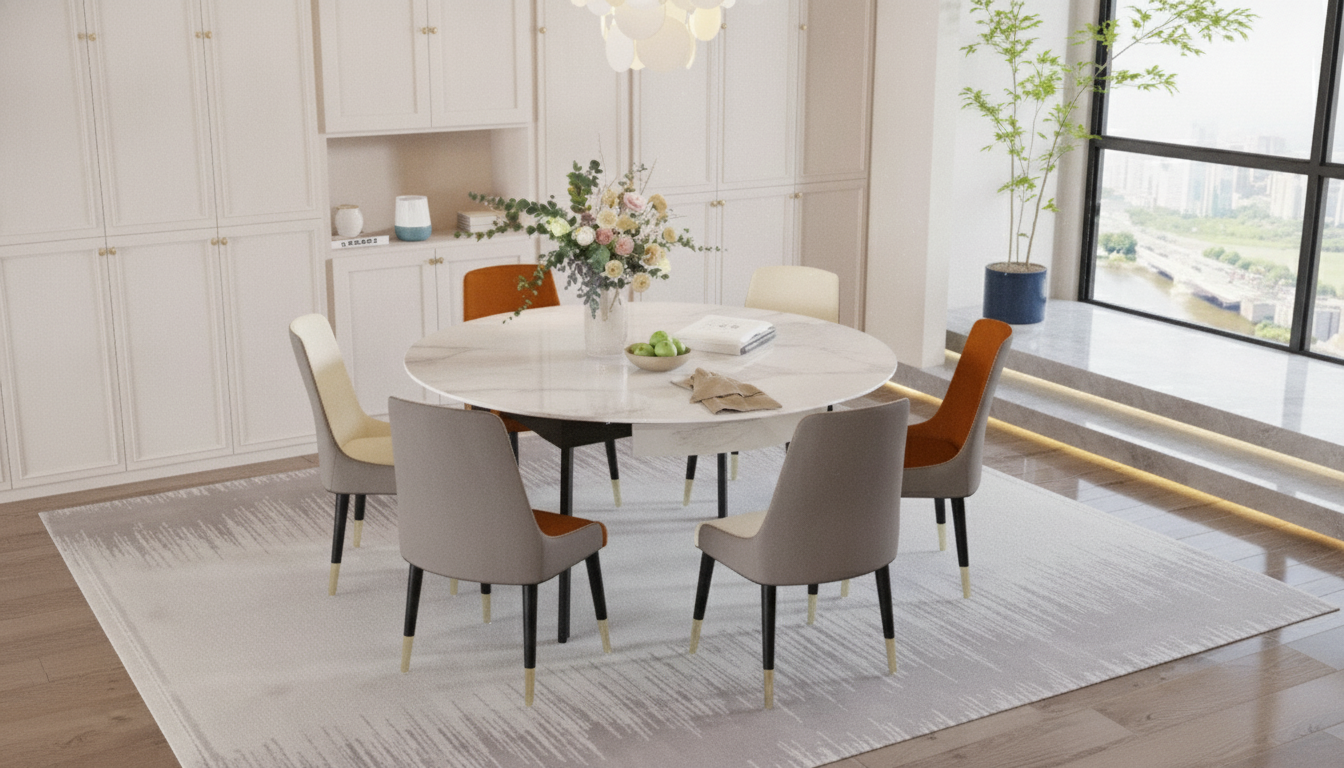
A round table keeps conversation easy and traffic flow smooth, while an extendable leaf adds room when guests arrive. A well-chosen round extendable dining table set can feel compact for everyday meals but still open up for birthdays, holidays, and game nights. Below is a practical guide to sizing, extension styles, materials, comfort, and care so the set works in real life—not just in a showroom.
Start with the room, not the seating count printed on a tag. Measure the dining zone and plan for comfortable clearance so chairs can slide out and people can walk behind seated diners. If the table sits near a wall, doorway, or buffet, verify there’s still a usable passage when chairs are occupied.
Always consider both configurations: the compact round size for everyday use and the extended footprint once the leaf is inserted. A table that “fits” closed can suddenly block a path when opened.
| Use case | Table size to consider | Seating expectation | Suggested clearance around table |
|---|---|---|---|
| Daily meals in a smaller space | Round ~36–44 in diameter | 4 seats | At least ~36 in for circulation when possible |
| Everyday plus occasional guests | Round ~44–52 in diameter | 4–6 seats | ~36–48 in improves comfort, especially near doorways |
| Hosting with leaf extended | Extended length commonly ~60–72 in (varies by design) | 6–8 seats depending on chair width | More clearance helps when people pass behind seated diners |
For additional space-planning references, the NKBA planning guidelines and the ADA design standards are helpful when thinking about circulation and clearances.
Regardless of style, check the build details that affect daily satisfaction: the extended surface should sit flush with minimal gaps, locks should engage firmly, and the table should feel stable without a soft “bounce” in the middle. For larger extensions, look for reinforced rails or support legs that bear weight when the table is open.
Dining tables live hard lives: heat from serving dishes, condensation rings, utensil taps, and constant wipe-downs. Materials and finishes determine whether the table ages gracefully or becomes high-maintenance.
For deeper background on how wood behaves and why stability varies by construction, the USDA Forest Products Laboratory Wood Handbook is a trusted reference.
A “6-seat” table can feel like a 4-seat table if the chairs are wide, have arms, or can’t tuck in. Confirm how many chairs come in the set and whether additional matching chairs are available later.
If you’re building out a cohesive dining zone, extra storage for linens, chargers, and serving pieces can make hosting easier. Consider pairing your table area with a streamlined storage piece like the Modern Nordic TV Stand and Storage Dresser for a clean, modern look that helps keep the dining space uncluttered.
In the round configuration, many tables comfortably seat 4, with larger diameters seating 5–6 depending on chair width. Adding a leaf often increases capacity by about 2 seats, especially if the extended length reaches the 60–72 inch range. Armchairs and extra-wide chairs can reduce the practical count.
They can if the extension hardware is light-duty or the leaf doesn’t lock in flush, but well-built tables remain solid when extended. Look for sturdy tracks, reinforced rails, and designs that add support (such as extra legs) when the leaf is in place.
Aim for roughly 36 inches around the table where possible for basic circulation, and consider 42–48 inches in tighter traffic zones or where people pass behind seated diners. You’ll want more space near doorways, walk-through paths, and buffets where chairs may be occupied while others move through.








Leave a comment