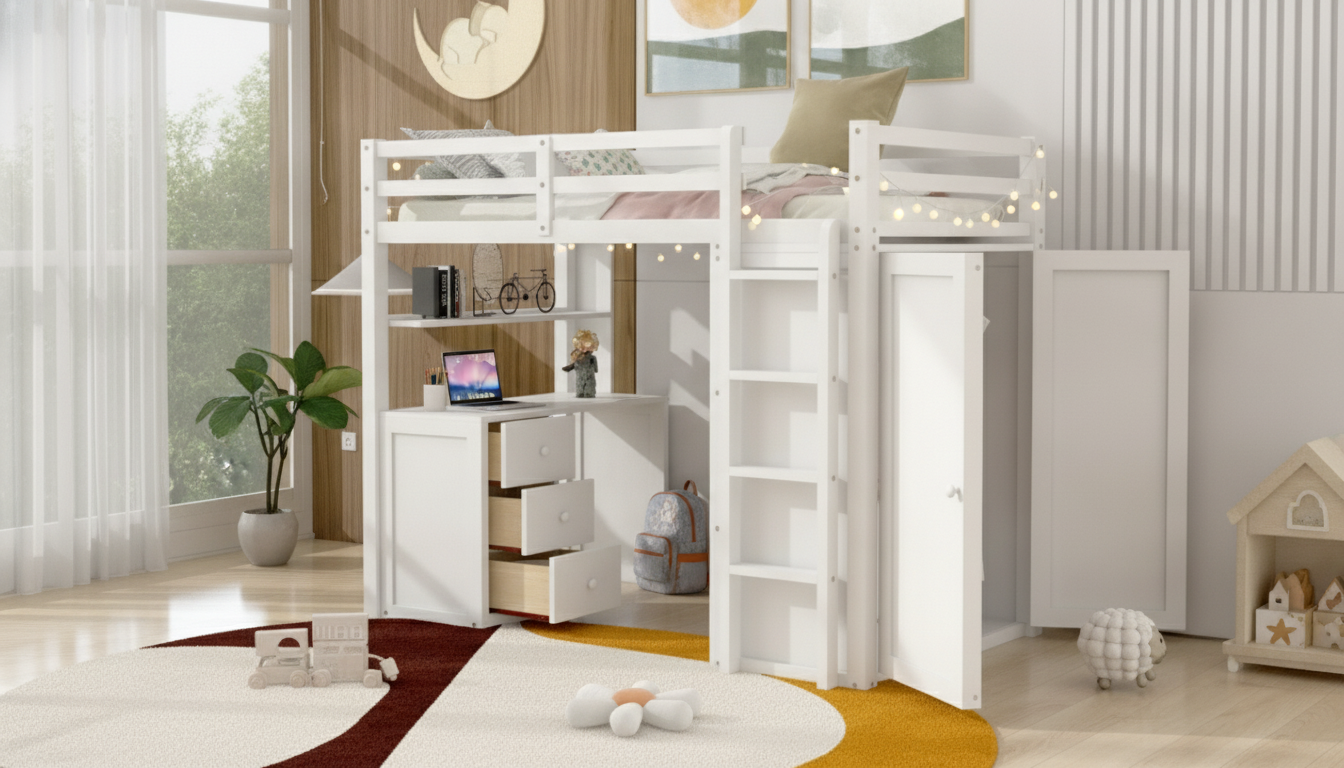
A loft bed that combines a sleep space with a desk, wardrobe, and drawers can turn one wall into a full bedroom setup. This style works especially well for shared rooms, small bedrooms, and kids or teens who need a dedicated study area without giving up storage.
When floor space is limited, the biggest challenge is fitting “daily life” into a room without it feeling like a storage unit. A twin loft bed with a built-in desk, wardrobe, and drawers helps by stacking functions vertically and grouping them into one organized zone.
If the room currently relies on plastic bins, overstuffed closets, or a desk squeezed into a corner, a combined loft system can make the space feel calmer and easier to maintain day-to-day.
A loft bed is a “commitment piece,” so a few careful measurements up front can prevent headaches later—especially in smaller bedrooms where doors, windows, and outlets matter.
For mattress planning, it helps to know standard sizing and thickness considerations; the Sleep Foundation’s twin mattress size guide is a useful reference point when checking fit and bedding.
Not all all-in-one loft systems are built the same. The best ones feel practical every day: drawers glide smoothly, the desk is actually comfortable to sit at, and the top bunk feels secure.
If the goal is a clean, one-wall bedroom solution, a dedicated system like the Twin Loft Bed with Desk, Wardrobe, and Storage Drawers can replace multiple mismatched pieces while keeping storage close to where it’s used.
Choosing between a combined loft bed and individual furniture pieces often comes down to floor space, how often the room layout changes, and how much visual clutter is tolerable.
| Need | Loft Bed with Desk + Wardrobe + Drawers | Separate Bed + Desk + Dresser |
|---|---|---|
| Open floor area for play/exercise | Often improved by lifting the bed | Often reduced by multiple pieces |
| One-stop storage for clothes and supplies | Built-in wardrobe and drawers | Requires at least one additional storage unit |
| Dedicated study nook | Integrated desk under loft | Desk competes for floor space |
| Future rearranging flexibility | More limited (single structure) | Higher (modular pieces) |
| Visual clutter control | Better with closed storage | Varies by furniture mix |
For additional safety context, consult the U.S. Consumer Product Safety Commission’s bunk bed safety requirements and the ASTM F1427 bunk bed safety specification, which manufacturers commonly use as a benchmark.
If extra closed storage is still needed elsewhere in the room (especially for shared spaces), a low, streamlined piece like the Modern Nordic TV Stand and Storage Dresser can add storage without crowding the walking path.
For kids and teens who like a focused study zone, pairing a tidy desktop with the right accessories can help reduce distractions—some families even reserve headphones strictly for homework time, like the White Tiger In-Ear Headphones with Hybrid Dual Driver & Planar Diaphragm.
Stay within the manufacturer’s stated mattress thickness limit so the guardrails remain tall enough to do their job. A thicker-than-recommended mattress can reduce effective rail height and increase fall risk.
Yes, if the desk depth and width allow space for the monitor base (or a monitor arm if permitted) plus working room for notebooks. Confirm legroom and make sure the chair can slide in comfortably without blocking drawers or doors.
Leave enough room to open doors and drawers fully and to stand in front of them comfortably—often about 24–36 inches depending on the hardware and room traffic. Also confirm the chair path at the desk doesn’t conflict with storage access.








Leave a comment