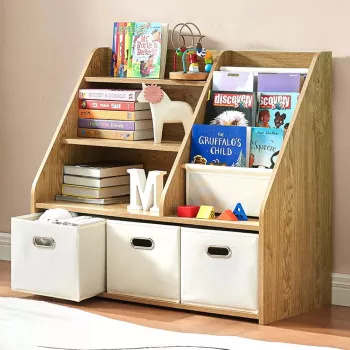
A kids bookshelf with toy storage bins makes it easier for children to find books, put toys away, and keep a bedroom or playroom feeling calm. The best designs balance safe height, sturdy construction, and clearly separated zones for reading and play—so cleanup becomes part of the routine, not a daily battle.
When books and toys share one organized “home,” kids can follow a simple system without needing constant reminders. That’s the real win: fewer piles on the floor and fewer small pieces disappearing under beds and couches.
A great organizer should feel intuitive to kids and reassuring to adults. Focus on safety, day-to-day usability, and a layout that still makes sense as your child’s interests change.
| Feature | Why it matters | What to check |
|---|---|---|
| Wall anchoring (anti-tip) | Prevents tip-over risk in active rooms | Included hardware or clear anchoring points |
| Rounded edges | Reduces bumps and snags | No sharp corners on top and shelf fronts |
| Removable bins | Makes sorting and transport easy | Bins slide/pull smoothly; handles if possible |
| Child-height access | Builds independence and habits | Kids can reach top shelf and bins safely |
| Durable surfaces | Holds up to daily use | Scratch resistance; easy wipe-down finish |
| Capacity planning | Avoids overflow clutter | Enough bins for categories; enough shelf room for favorite books |
The organizer matters, but the setup is what makes it “stick.” A few small choices can turn cleanup into a quick reset instead of an end-of-day standoff.
Kids’ rooms are active spaces—furniture gets bumped, leaned on, and sometimes climbed. Safety features and simple maintenance reduce risk and extend the life of the unit.
For additional safety guidance, review the CPSC furniture tip-over prevention recommendations and the American Academy of Pediatrics home safety guidance. For toy safety context, the ASTM F963 overview is a helpful reference.
If the goal is one tidy footprint that supports both reading and play, Kids Bookshelf with Toy Storage Bins is a straightforward solution that keeps the routine simple: books up top, toys in bins, and everything easy to reach.
| Item | Details |
|---|---|
| Product | Kids Bookshelf with Toy Storage Bins |
| Price | 196.01 USD |
| Availability | In stock |
A combined unit simplifies the “put-away map” for kids—books go on shelves, toys go in bins—so clutter is less likely to spread. Separate pieces can still work well when you need higher capacity or different heights for specific items.
Starting with 4–6 categories is usually plenty for daily cleanup, especially if extra toys rotate in and out of a closet. Fewer, clearly defined bins often work better than lots of half-filled bins that confuse sorting.
Anchoring is strongly recommended for taller or climbable furniture to reduce tip-over risk. Follow the manufacturer’s instructions and keep heavier items in lower bins to help stability.








Leave a comment