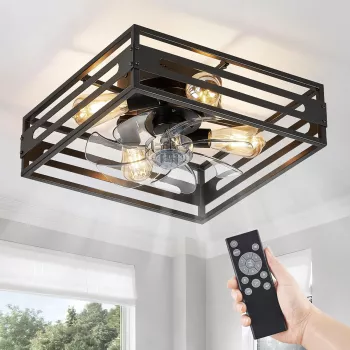
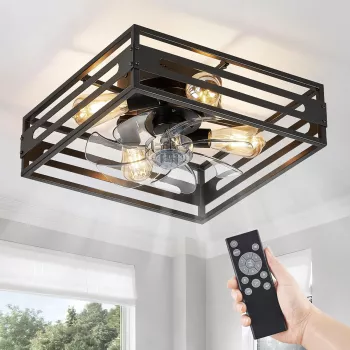
A square caged flush-mount ceiling fan brings together airflow and ceiling lighting in one compact fixture. Because it sits close to the ceiling, it’s a smart option for rooms where headroom matters, while the square cage adds a clean, geometric look that leans modern with a hint of industrial edge. Add a remote control, six speeds, and a reversible motor, and you get a practical setup designed for everyday comfort in every season. For more guidance, see 5 Best Ceiling Fans of 2026, Lab-Tested and Reviewed.
Compared to traditional downrod fans and open-blade designs, this style stands out for both function and appearance. It’s built to keep the ceiling line tidy while still delivering noticeable circulation and useful overhead light. For further reading, see Ceiling fan – Wikipedia.
In day-to-day use, the biggest advantage is flexibility. A multi-speed motor and handheld control make it easier to match the fan’s performance to what you’re doing—sleeping, working, cooking, or hosting.
For energy-smart habits, ceiling fans are commonly used to improve comfort so thermostat settings can be adjusted modestly while still feeling good. For practical guidance on efficient fan use, see the U.S. Department of Energy’s overview on using ceiling fans.
This snapshot helps compare the key elements that matter most when shopping for a low-profile caged fan with lighting.
| Feature | What it does | Why it matters |
|---|---|---|
| Flush-mount design | Mounts close to the ceiling | Useful for maintaining clearance in lower-ceiling rooms |
| Square caged frame | Encloses blades within a geometric cage | Adds a modern/industrial accent and a guarded appearance |
| Integrated light | Provides ceiling illumination | Reduces the need for a separate light fixture |
| Remote control | Controls fan speed and lighting from around the room | Convenient in bedrooms, offices, and living areas |
| 6-speed motor | Multiple airflow levels | Fine control for comfort and noise preference |
| Reversible direction | Switches airflow direction | Supports year-round circulation strategies |
A square caged flush-mount fan is versatile, but it shines most in rooms where a compact footprint, streamlined look, and easy control matter.
Ceiling fans have different mounting and support needs than basic light fixtures. A careful setup helps with safety, performance, and long-term reliability.
For broader electrical safety reminders around home wiring and fixtures, review the NFPA’s electrical safety resources.
A reversible motor isn’t just a bonus feature—it’s one of the most useful tools for making a room feel more consistent throughout the year.
For additional efficiency notes and fan performance guidance, ENERGY STAR provides a helpful overview of ceiling fan considerations.
Yes—flush-mount fans are designed to sit close to the ceiling to help preserve clearance. For safe operation and comfortable airflow, confirm your room height and follow the manufacturer’s clearance requirements.
A 6-speed fan offers finer airflow control, making it easier to choose a gentle setting for sleep or a stronger setting for busy times. The extra steps can also help you land on a speed that feels quieter and more comfortable for your space.
In winter, reversing the fan direction typically creates an updraft that helps mix warmer air near the ceiling back into the living space. It supports circulation and comfort, but it doesn’t generate heat on its own.










Leave a comment